
Almost every teacher has seen it.
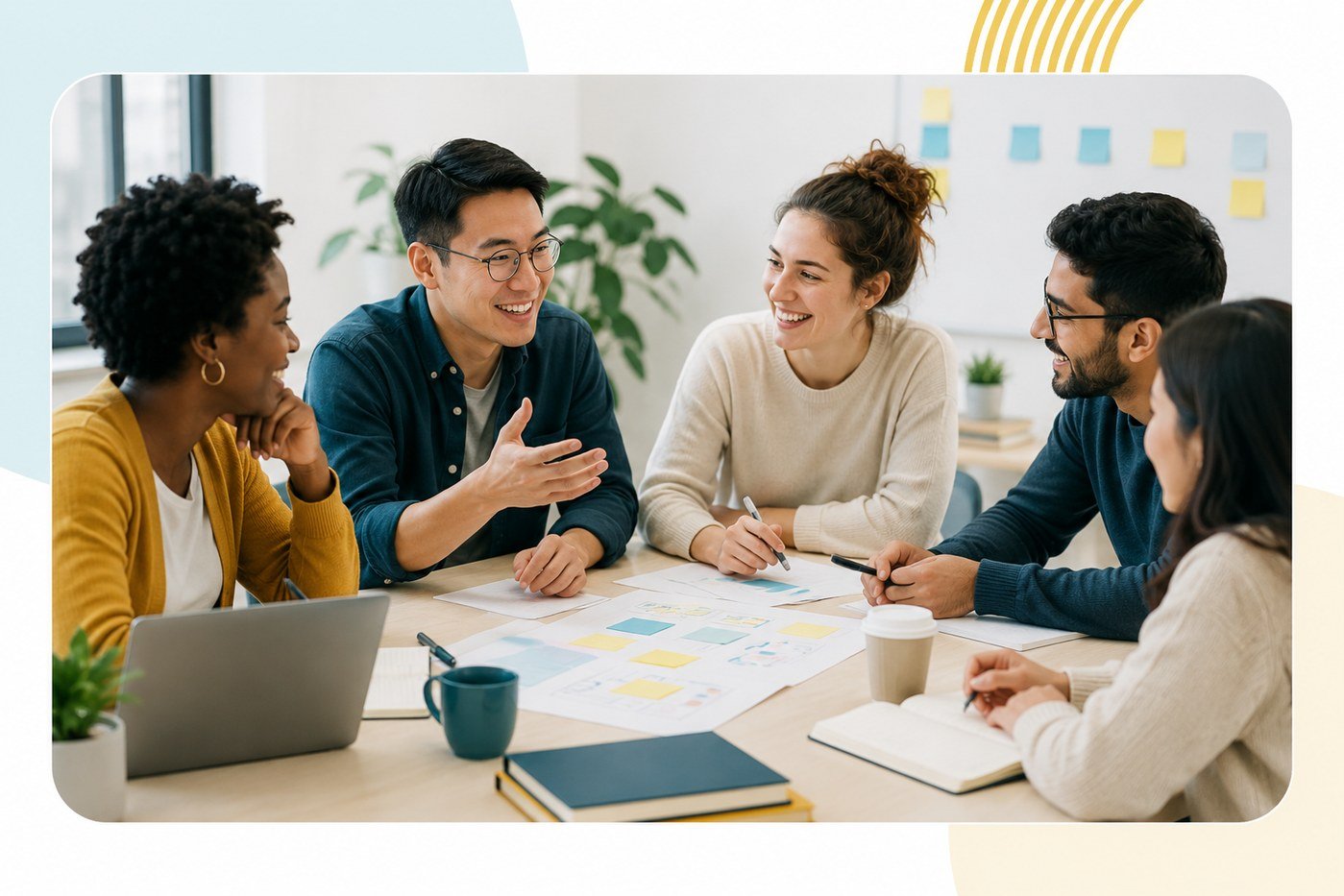
Students sit in groups. They have a worksheet, poster paper, or shared document. From the outside, it looks like collaboration. Desks are close together. Students are talking. The activity is called “group work,” but we are not always sure that the learning is shared.
Putting students into groups is only the beginning. Real collaboration needs careful design. Students need clear responsibilities, a task that connects their contributions, and moments where they must listen, explain, decide, and build something together. As Dillenbourg (1999) reminds us, collaborative learning is not guaranteed simply because students are placed together. It depends on the quality of the interaction that occurs between learners.
Two small design shifts can help teachers move from group work to real collaboration: assigning responsibility-based roles and creating interdependent tasks.
Assigning responsibility-based roles
Many teachers use roles in group work. We may assign a leader, writer, presenter, timekeeper, or materials manager. The intention is good. Roles can help students know what to do and help the group stay organized. But roles often fail when they are only labels.
A student may be called the “leader” but still not know what leadership looks like. A “writer” may simply copy the final answer. In these cases, the role exists, but the responsibility is weak.
A stronger role does three things. It tells the student exactly what action to take. It connects that action to the group outcome. It also makes the student’s contribution visible enough for the teacher and peers to notice.
Instead of saying, “You’re the recorder,” we might add: “You must write down every idea from your group before you choose the best one.”
Now the role has real responsibility. The student is not only holding a title. They are protecting an important part of the group’s work.
This also support individual accountability, which Johnson and Johnson (2018) identify as one of the important elements of cooperative learning. Each learner should know that their contribution is needed, not optional.
However, even well-designed roles can disappear after five minutes if the teacher does not keep them alive.
One helpful move is to call on roles, not only names. Instead of saying, “Rosa, what did your group decide?” the teacher can say, “Evidence Checker, what evidence did your group use?” This simple shift reminds students that their role has real classroom value.
Another move is to rotate roles regularly. If the same student always leads and the same student always records, group work may only strengthen existing habits. Rotating roles allows students to experience different kinds of contribution. A quiet student may learn to summarize ideas. A confident speaker may learn to listen and record carefully.
A third move is to pause and check responsibility: “Before you continue, Recorder, can you check if everyone has shared their ideas?” This small pause helps students notice collaboration while it is still happening. It also gives the teacher a chance to guide the group before the final product is finished.
Designing interdependent tasks
Real collaboration begins when students cannot complete the task well unless they use one another’s contributions. In cooperative learning, this is often described as positive interdependence: students understand that their success is linked to the success of others (Johnson & Johnson, 2018).
Teachers can build interdependence in three practical ways.
The first is to split information. Give students different pieces of information so they need to listen to one another before completing the task. For example, in a reading activity, each student may read one short section and then teach the key idea to the group.
The second is to split responsibility. In a science poster, for example, one student may collect data, another may draw and label the diagram, and another may explain the process. The poster cannot be completed well unless all parts come together.
The third is to require a shared output. Instead of four separate answers placed on one paper, the group must produce one final decision, explanation, product, or presentation. This asks students to discuss, compare, and agree.
The point is not to make the task complicated. The point is to make the task connected. Each student should have something useful to bring, and the group should need those contributions to succeed.
Interdependent tasks still need teacher support. Without support, students may divide the work too quickly and stop interacting.
One simple rule can help: everyone must be able to explain. This does not mean every student must say the same thing in the same way. It means each student should understand the group’s final answer enough to explain their part and how it connects to the whole. Teachers can pause before students finish the task and ask, “Can each person explain how their part supports the group’s final answer?” This small check keeps collaboration alive until the end of the activity.
A final reflection
Productive collaboration is not created by moving desks. It is created by design.
When roles are responsibility-based, students know how they contribute. When tasks are interdependent, students need one another. When teachers pause, rotate, check, and call on roles, collaboration becomes more than a classroom arrangement. It becomes a learning habit.
These techniques can change the quality of classroom interaction. They help teachers move beyond group work as an activity format and toward collaboration as a learning experience.
References
Dillenbourg, P. (1999). What do you mean by collaborative learning? In P. Dillenbourg (Ed.), Collaborative learning: Cognitive and computational approaches (pp. 1–19). Elsevier.
Johnson, D. W., & Johnson, R. T. (2018). Cooperative learning: The foundation for active learning. In S. M. Brito (Ed.), Active learning: Beyond the future. IntechOpen. https://doi.org/10.5772/intechopen.81086
About the Author
Dr. Le Dinh Bao Quoc is an educator, author, and co-founder of Voices of Change. He is also Founder and CEO of Pro.Ed Education Solutions and Head of EduVerse, a global professional development network for educators. His work focuses on teacher development, educational leadership, AI in education, and practical innovation that helps educators grow with purpose and impact.