

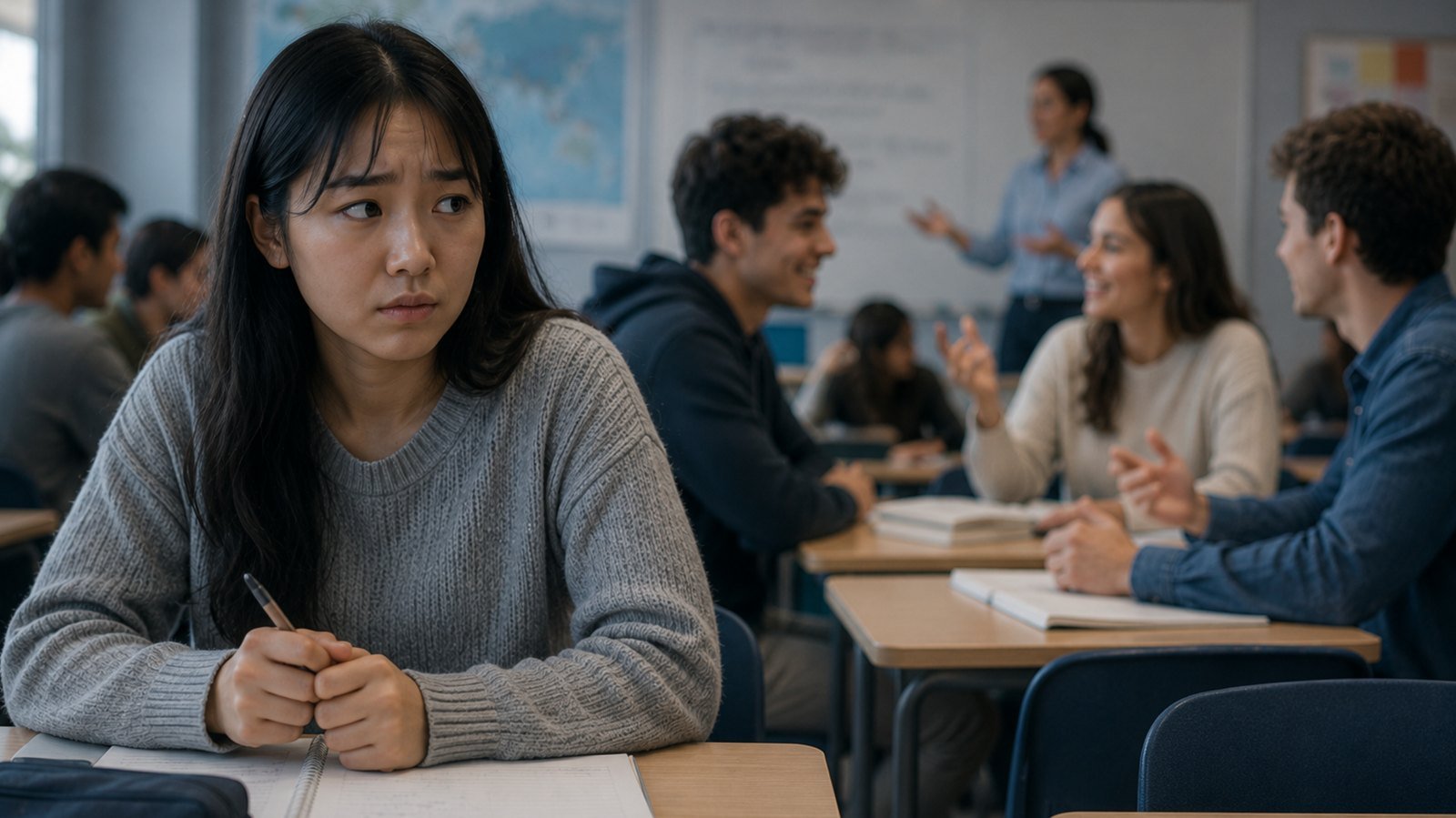
Mina felt the familiar tightening in her chest the moment she walked into class.
She had reviewed her notes. She had practiced her sentences. She had even whispered her ideas to herself on the train. But none of that mattered now. The moment she saw her classmates chatting confidently, her mind began its usual spiral.
What if I make a mistake? What if they think I sound strange? What if I freeze again?
When the teacher asked for volunteers, Mina looked down, hoping her silence would make her invisible.
It didn’t.
Her name was called. Her heart thumped. Her throat dried. She stood up, already imagining everything that could go wrong. She rushed her words. She stumbled. Someone corrected her mid-sentence. A few students whispered. Her face burned. She sat down quickly, wishing she could disappear.
Group work wasn’t much better. One student dominated the conversation. Another spoke so fluently that Mina felt like she didn’t belong. She tried to contribute but couldn’t find the right moment. When she finally spoke, she stumbled again. Someone corrected her again. She withdrew for the rest of the activity.
And when her teacher announced an upcoming real-time virtual exchange with students overseas, her anxiety skyrocketed.
Speaking English with strangers. On camera. With unpredictable questions, unfamiliar accents, and the pressure of synchronous communication.
She didn’t sleep well the night before.
During the exchange, her internet lagged. She misheard her partner. She apologized repeatedly. She felt overwhelmed by the pace, the accents, the cultural differences, the pressure to perform. When the session ended, she closed her laptop and cried—not because she didn’t care, but because she cared too much.
Mina’s story is not unusual. It is the quiet reality many learners carry into our classrooms every day.
Where Anxiety Comes From?
Learners like Mina often walk into class with unrealistic expectations about what “good” language ability should look like. They fear mistakes. They fear judgement. They fear being exposed as “not good enough.” Their confidence is fragile, and the classroom—especially a language classroom—can feel like a spotlight they never asked for.
Teachers, without meaning to, can add to this pressure. Correcting errors too quickly. Calling out mistakes publicly. Giving feedback at moments when students already feel vulnerable. A small worry becomes a full-blown panic.
Course design can amplify anxiety too. Difficult content without proper preparation. Tests that feel unpredictable. Activities where scores are visible to everyone. Even fun tools like Kahoot or Quizlet can become stressful when students repeatedly see themselves at the bottom of the leaderboard.
Group work, meant to encourage communication, can also isolate. A shy student placed with dominant personalities or higher-level speakers may feel silenced before they even begin. And in today’s world—where digital communication is constant—face-to-face speaking can feel even more intimidating.
Real-time virtual exchanges add another layer. They reduce some pressures by offering the safety of a screen, but they introduce new ones: the intensity of synchronous communication, unfamiliar partners, unpredictable cultural norms, and the cognitive load of managing language, technology, and social interaction all at once.
Anxiety isn’t just “feeling nervous.” It shapes attention. It shapes memory. It shapes identity.
And it can make a student believe they are “bad at languages,” even when they’re not.
What Teachers Can Actually Do?
Here’s the truth we often avoid:
We cannot make people comfortable.
Comfort is not something we can deliver. It is something learners arrive at themselves.

But we can create conditions where comfort becomes more likely. And that is more powerful than most teachers realize.
We can give students time to plan before speaking—time to organize their ideas, rehearse quietly, and prepare for possible reactions. We can scaffold tasks so that support gradually fades, allowing learners to stretch without snapping. We can group students thoughtfully, matching levels and personalities so that communication feels possible rather than overwhelming.
We can rethink correction, saving it for moments when students are calm enough to absorb it. Sometimes the best correction is none at all. Sometimes it is delayed. Sometimes it is gentle. Timing matters more than technique.
We can use AI carefully—not as a shortcut, but as a warm-up partner. AI can help students rehearse, explore ideas, and build confidence before speaking to real people. But it must be used as a guide, not a crutch.
And in online exchange spaces like Culture Club, we’ve seen these ideas work. When learners are given thoughtful preparation, supportive leadership, and low-pressure global conversations, anxiety doesn’t disappear—but it softens. Students speak more. They smile more. They grow.
None of these strategies eliminate anxiety. Nothing will.
But they make space for courage. And courage is what learners need most.
A Different Version of Mina’s Story
Imagine Mina again—but this time, the classroom is different.
Before speaking, she gets a few minutes to plan her ideas. She rehearses quietly with a partner. When she stands up, she feels prepared—not perfect, but ready. Her teacher listens without interrupting. Corrections come later, gently, after the task, when she is calm enough to absorb them.
During group work, she is placed with students at similar levels. The conversation flows. She contributes more. She feels heard. She feels capable.
Her teacher designs tasks that build confidence step by step. Each week, the challenge increases slightly—more output, more complexity, fewer notes—but never so much that she feels overwhelmed.
Before the virtual exchange, she practices with an AI chatbot to warm up her speaking. She knows what kinds of questions might appear. She has a plan for what to say if she gets stuck. She enters the exchange with curiosity instead of fear.
Her partner is kind. The pace feels manageable. She laughs. She learns. She finishes the session proud of herself.
This version of Mina is not imaginary. It is the learner who emerges when anxiety is understood, supported, and gently challenged.
The Path Forward
We cannot remove anxiety. We cannot guarantee comfort. We cannot promise confidence.
But we can create conditions where comfort becomes possible, courage becomes likely, and growth becomes inevitable.
And that is more powerful than we realize.
Anxiety will always be part of learning. But it doesn’t have to control it.
By Robert Stroud
https://www.joincultureclub.com
About the Author
Dr. Robert Stroud is a professor based in Tokyo, Japan, whose work explores how community, intercultural communication, and emerging technologies can create more meaningful learning experiences. He is passionate about helping students and educators build confidence, collaborate across cultures, and foster genuine human connection in an increasingly digital world. Robert is the creator of Culture Club, an international virtual exchange project, the founding editor of The University Grapevine, and a co-founder of Voices of Change (VOC). An internationally recognized TEDx speaker, he advocates for educational approaches that use technology to strengthen—not replace—the relationships at the heart of learning.