

Imagine two university students submitting their final English essays. Kenji receives 92%. His essay is beautifully written, with sophisticated vocabulary, convincing arguments, and almost flawless grammar. Jane receives 75%. Her essay contains some language mistakes, and her arguments are not always clearly expressed. Looking at their grades, most people would probably conclude that Kenji performed better.
But what if we looked more closely at how they completed their assignments?
Two Students, Two Very Different Learning Journeys
Kenji began with a few basic ideas in Japanese before using ChatGPT to organise his thoughts, strengthen his arguments, and improve his English. Within a relatively short time, he had produced an impressive essay. Jane took a different approach. She spent hours planning, researching, and writing, struggling with vocabulary, reconsidering her arguments, making mistakes, and revising several drafts. Her final essay was less polished, but she had engaged in numerous activities that potentially contributed to her learning.
So, who actually learned more?
We cannot know simply by comparing their grades. Kenji may have developed valuable skills through his interactions with AI, while Jane may have strengthened her writing abilities through independent effort. Equally, spending longer on an assignment does not automatically mean greater learning. What matters is that their grades reveal very little about the thinking, decisions, and experiences behind their work.
Are we assessing students' learning, or simply the quality of what they submit?
The Learning Iceberg: What Lies Beneath the Surface?
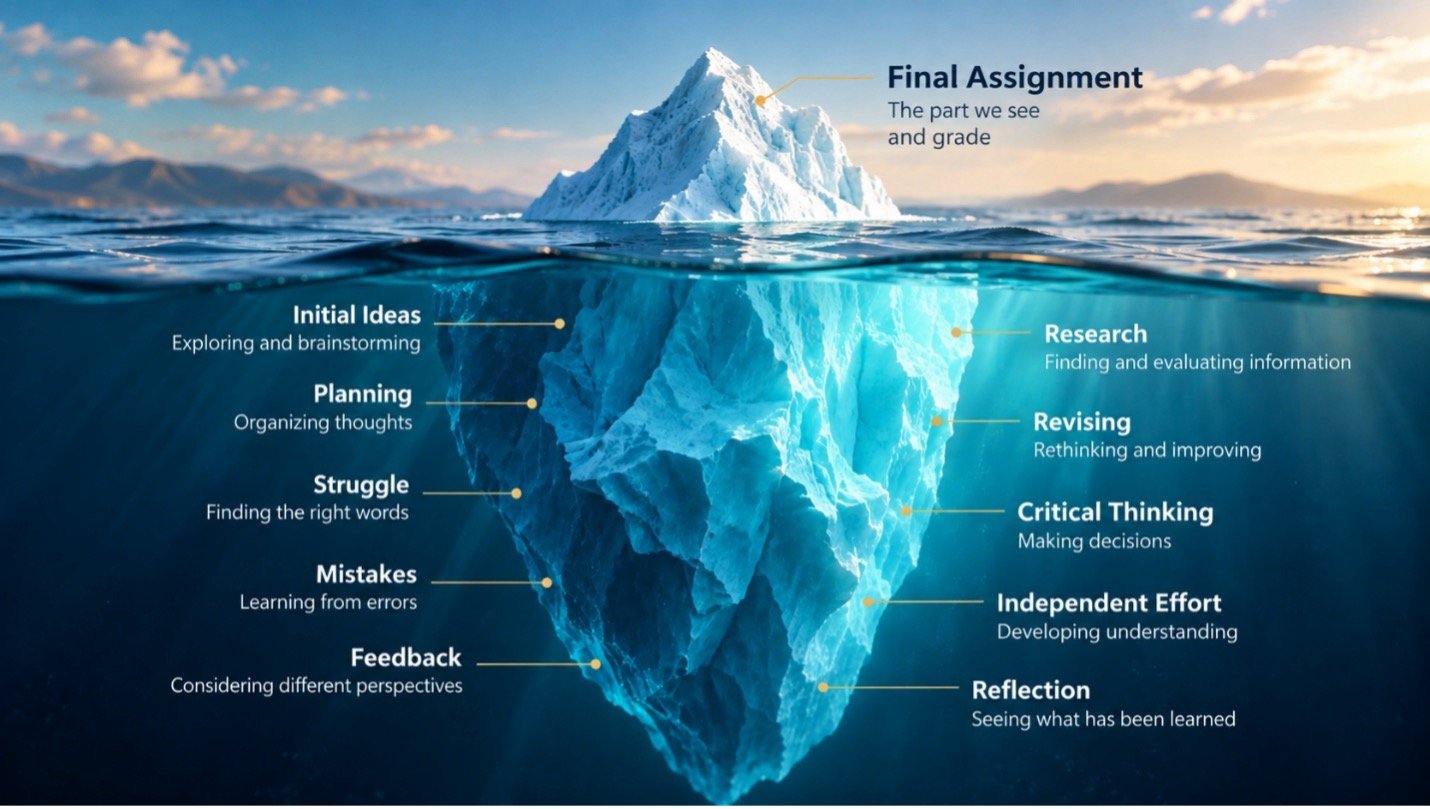
The iceberg offers a useful metaphor.
Above the water sits the final assignment: the visible product teachers read, evaluate, and grade. Beneath the surface are the less visible activities that may have shaped it: initial ideas, planning, research, struggle, mistakes, feedback, revision, critical thinking, independent effort, and reflection.
When students struggle to express an idea, for example, they may recognise gaps in vocabulary, question their understanding, or discover weaknesses in their arguments. When they receive feedback, they have opportunities to reconsider their thinking and make decisions about improvement. Even mistakes can become valuable learning experiences when students recognise and respond to them. These activities do not guarantee learning, but they create opportunities to develop knowledge, skills, and independence. And yet, much of this remains hidden beneath the surface.
The iceberg reminds us that the work we grade is not necessarily the same as the learning we want to develop. A polished assignment may demonstrate considerable ability, but it may also conceal how much assistance was received and which learning opportunities were missed.
How AI Changes the Learning Process
Generative AI makes this distinction particularly important. Students can now use technology to generate ideas, organise arguments, improve language, and produce sophisticated assignments. Used thoughtfully, AI can support learning through explanations, feedback, and opportunities for experimentation.
A student might ask ChatGPT to identify weaknesses in an argument, evaluate its suggestions, reject some, and independently revise others. This involves reflection, judgment, and decision-making. Another student might simply ask AI to complete an assignment and submit the result with minimal engagement. Both students may produce strong work. But the learning taking place beneath the surface could be very different.
Much of the debate about AI in education focuses on cheating, detection software, and institutional policies. These concerns are understandable, but they do not address the entire problem. Even when AI use is permitted, educators need to distinguish between what students can accomplish independently, what they can produce with technological assistance, and how effectively they evaluate AI-generated content.
The question is not simply whether students use AI, but whether they remain actively involved in the thinking and learning processes.
Bringing the Hidden Learning Process Into View
If the final assignment reveals only part of the picture, how can teachers make learning more visible? One approach is to collect selected evidence of the processes students engage in before submitting their work. This does not mean examining every draft or reviewing every AI conversation. Such expectations would be unrealistic, particularly in large university classes. Instead, small changes to assessment design can provide meaningful insights without creating excessive workloads.
For example, students might submit a brief outline showing their initial ideas before using AI assistance. Alongside their final essay, they could identify two important revisions and explain why they made them. If they used ChatGPT, they might describe one suggestion they accepted and another they rejected, demonstrating how they evaluated feedback rather than simply following it. Occasional short activities completed without AI assistance could also provide evidence of independent abilities.
These approaches are not perfect. Students can fabricate reflections or drafting histories, and additional requirements must remain fair and manageable. Nevertheless, combining selected evidence of the learning process with the finished product can provide a stronger basis for assessment.
Sometimes, a short explanation can reveal more than another page of polished writing.
Rethinking What Success Looks Like
Return to Kenji and Jane.
Kenji still receives recognition for producing an excellent essay, but his teacher also asks him to explain how he used AI and why he made particular decisions. Jane submits selected drafts demonstrating how her writing developed through planning, feedback, and revision. Their final grades might remain unchanged, but their teacher now has a clearer understanding of what each student can accomplish and where further support might be needed.
This does not mean rewarding effort simply because someone worked hard. Jane's longer hours do not automatically prove that she learned more than Kenji. Rather, it means recognising that educational achievement involves more than the quality of a finished product. If assessment focuses entirely on polished outcomes, students will naturally concentrate on producing them. When we also value reasoning, revision, reflection, and independent judgment, we communicate that these processes are part of learning too.
Perhaps generative AI is encouraging us to reconsider something that deserved attention long before ChatGPT appeared. Have we become too focused on what students produce and not focused enough on what they learn along the way?
The stories of Kenji and Jane remind us that a higher grade does not necessarily indicate greater learning. The iceberg reminds us that much of the learning process remains hidden beneath the finished assignment. Together, they challenge us to reconsider what we value and assess.
AI can help students produce better work. Our challenge is to ensure that it also helps them become better learners.
Ultimately, the real success of education is not simply what students submit today, but the knowledge, abilities, and judgment they carry into tomorrow.


Join the Conversation
Share a reflection, question, or idea sparked by this article. Please keep the conversation respectful and constructive.