
When English Becomes a Bridge
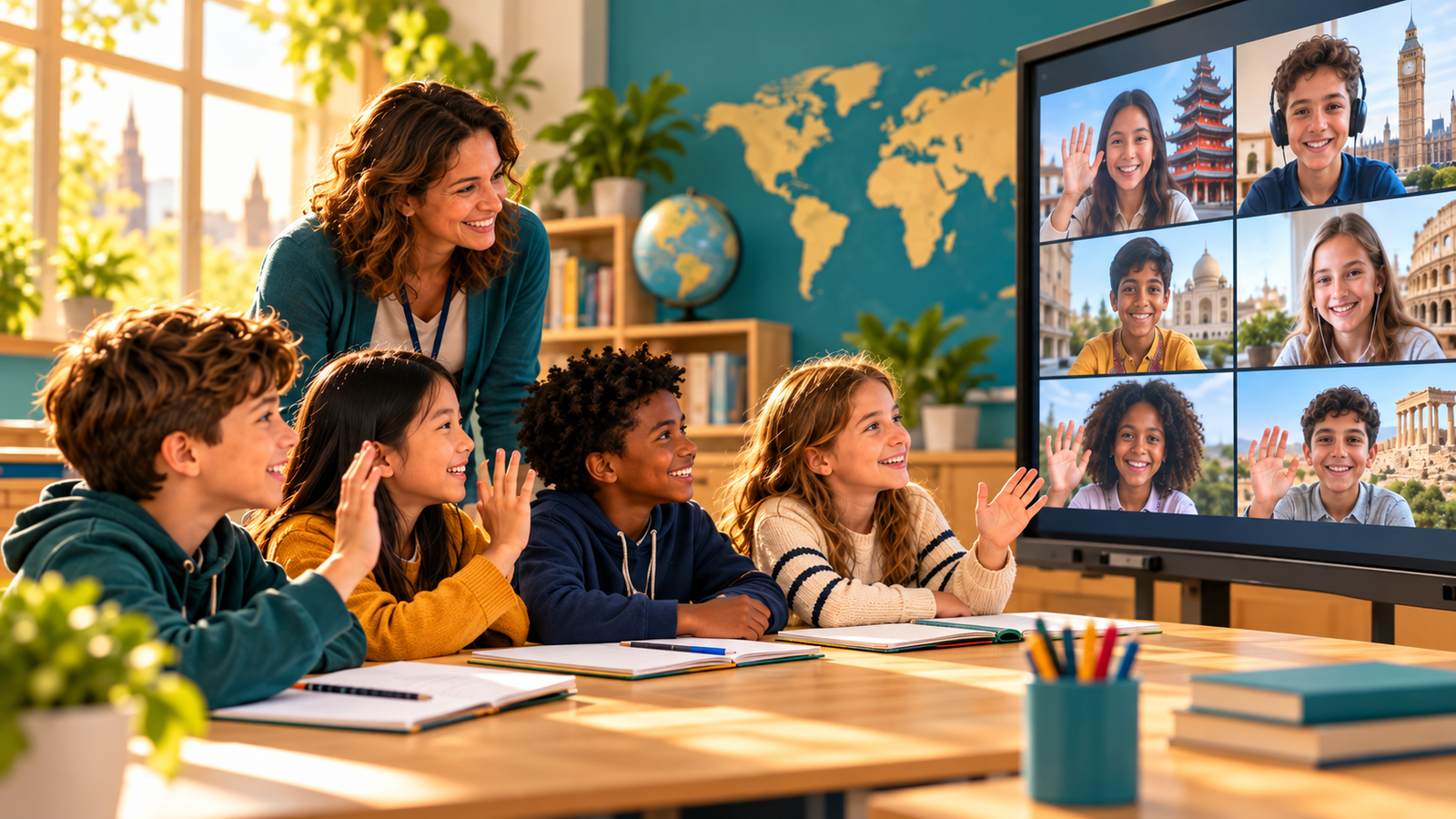
What happens when children discover that the English they learn at school can connect them with people thousands of kilometers away? For many young learners, opportunities to use English beyond classroom exercises are limited. “Guess Who’s in My Classroom This Month?” was designed to change that by bringing international teachers and students into live online conversations.
The idea was straightforward: instead of only reading about other countries, learners could meet people who lived there, exchange questions and discover the everyday realities behind familiar or unfamiliar places.
Bringing the World into the Classroom
The initiative took place during the 2022–2023 school year in Serik, Antalya, Türkiye, involving 100 fourth-grade pupils at a public primary school and 37 learners at Serik Science and Art Centre (Serik BİLSEM), which provides enrichment education for gifted and talented students. Teachers and students from schools in the United States, Brazil, Ecuador, the Canary Islands, Canada, Qatar, Egypt, Moldova and Greece joined the exchanges. Meetings were held during school hours on Zoom, lasted no longer than 50 minutes and were supervised by teachers. Participants shared short presentations, photographs and videos about their cities, countries and schools. Students introduced themselves and then took part in reciprocal question-and-answer sessions. English was no longer simply a subject to study: it became the language students needed to communicate with real people. The format supported curriculum goals related to speaking, understanding messages and interaction, while offering opportunities to experience cultural diversity firsthand.
Beyond Vocabulary and Grammar
The conversations introduced students to different school routines, traditions and ways of life. They also revealed similarities: young people in different countries could recognise shared interests, questions and experiences. According to the teachers’ observations, students approached the encounters with enthusiasm and became more willing to use English. Some interactions prompted students to reconsider assumptions about particular countries; others gave them positive first impressions of places they had previously known little about. These are valuable indications of intercultural learning, although they should not be interpreted as proof of lasting attitude change.
The meetings also gave students experiences to discuss with their families and teachers. Feedback from students and parents, collected through questionnaires developed with expert input, was positive. Respondents described the approach as enjoyable, creative and different from ordinary lessons. As the project did not report a controlled evaluation or quantitative learning gains, these findings are best understood as participant feedback and classroom observations.
How Other Schools Can Adapt the Practice
The model does not depend on travel or a large project budget. What matters is purposeful preparation, reliable partners and an opportunity for students on both sides to contribute. A school hoping to try a similar approach could begin with one partner class and one carefully planned meeting.
Before the exchange, teachers can agree on shared learning goals and a simple agenda, help students prepare introductions and open-ended questions, and choose a few visual materials. During the meeting, both groups should have time to speak, listen and ask follow-up questions rather than watch a one-way presentation. Afterwards, a short reflection can help students identify what surprised them, what they had in common and whether any assumptions were challenged. Safeguarding should be part of the design from the outset. In this initiative, school administrators and parents provided the necessary permissions, teachers supervised the sessions, and meetings were not recorded. Clear agreements on participation, privacy and appropriate interaction were essential when children meet online.
Small Encounters, Wider Horizons
“Guess Who’s in My Classroom This Month?” shows how modest digital tools can support meaningful international collaboration. Its contribution was not technological novelty but the opportunity to practise English with a genuine purpose and encounter different perspectives through human interaction. In line with the aspirations of Sustainable Development Goal 4 for quality education, this experience offers an adaptable practice for schools seeking to make language learning more inclusive, engaging and connected to the wider world. Sometimes a global learning opportunity begins with a simple classroom question: Who will we meet this month?
Join the Conversation
Share a reflection, question, or idea sparked by this article. Please keep the conversation respectful and constructive.